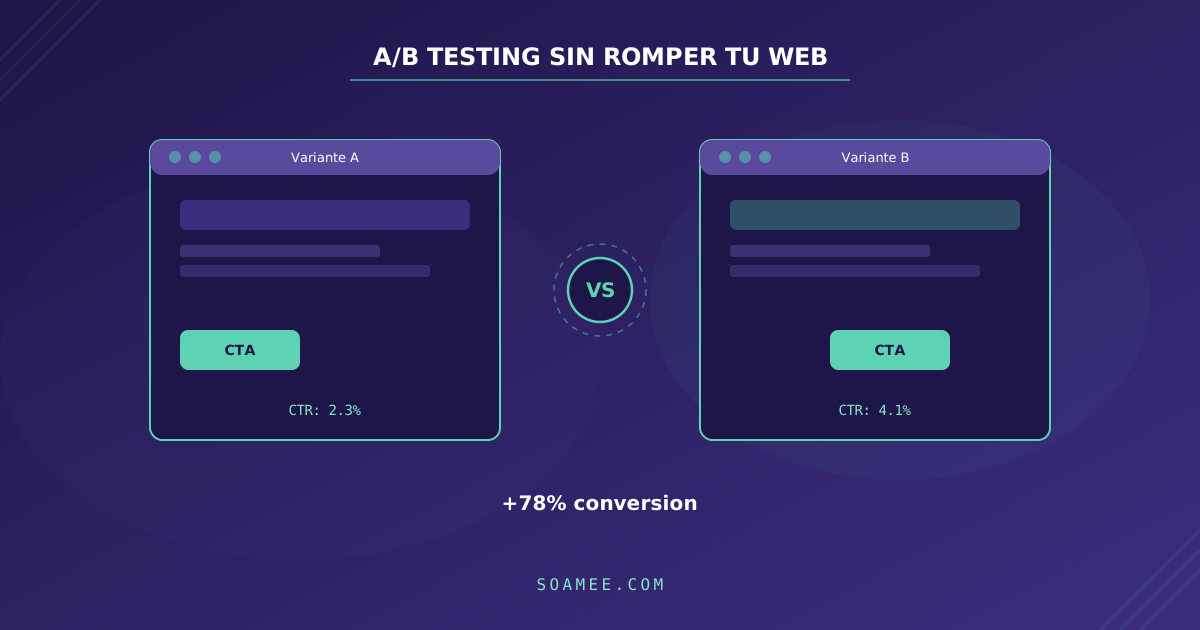
There is a cruel irony in the A/B testing world: the tool you installed to improve conversion may be sinking it. A poorly integrated client-side testing script adds hundreds of milliseconds of blocking JavaScript, causes that flash where the user sees the original version before the variant appears, and degrades the Core Web Vitals that Google uses to rank — and that your users suffer on every visit, whether or not they are in a test.
In our CRO guide we cover the process: research, hypotheses, prioritization. Here we get into what almost nobody covers: how to execute the tests technically without paying a performance toll, without scares from Google, and without false conclusions.
The hidden cost of client-side testers
Most popular A/B testing tools work the same way: you insert a JavaScript snippet, and that script downloads the experiment configuration, decides which variant the user sees, and modifies the DOM on the fly. Convenient for marketing, expensive for everyone else:
- Flicker (or FOOC, flash of original content): the browser paints the original page and, milliseconds later, the script rewrites it. The user watches the change happen. Besides feeling like a broken website, it contaminates the experiment — the variant you are testing is not “the new hero”, it is “the old hero mutating in front of you”.
- Blocking JavaScript: to avoid flicker, many tools recommend loading their script synchronously in the
<head>, or worse, with an “anti-flicker snippet” that hides the entire page until the script decides. Translation: your LCP gets worse for 100% of visits, including the ones not participating in any test. - The conversion paradox: Core Web Vitals directly affect conversion, especially on mobile. If your tester adds 300-500 ms of blocking, every test needs to win by quite a bit just to compensate for what the tester itself takes away. You are measuring +5% improvements with a tool that cost you a -3% baseline.
This does not mean client-side is forbidden — it means it has a cost that must be measured. If you install a tester, compare your Core Web Vitals before and after. Many teams discover that their “experimentation program” was, on net, a performance degradation program.
What Google says about testing and SEO
The fear that “A/B tests hurt SEO” is one of the most persistent myths. Google’s position is public and quite reasonable: experimenting is allowed, under four conditions:
rel=canonicalon the variants. If you serve the variant on another URL (/landing-b), that URL must point to the original with a canonical. That way Google understands it is not duplicate content, but a temporary variation of the same page.- 302 redirects, not 301. If you redirect traffic to the variant, use a temporary redirect (302). A 301 tells Google the change is permanent and can transfer indexing to the test URL.
- No cloaking. Googlebot must be able to see the same thing as any user: if you detect the bot and always serve it the original version “just in case”, that is cloaking and it is indeed grounds for a penalty. Let the bot join the split like any other user.
- Limited duration. An experiment is temporary by definition. When the test concludes, ship the winning variant and remove the machinery. A test “alive” for eight months stops being an experiment and starts looking like duplicate content with decoration.
If you comply with this, the real SEO risk of an A/B test does not come from Google misinterpreting it: it comes from blocking JavaScript degrading your Core Web Vitals. Which is exactly the previous point.
Server-side and feature flags: the serious alternative
In server-side testing, the decision of which variant to serve is made on the server (or at the edge) before rendering. The user directly receives the version assigned to them: no third-party scripts rewriting the DOM, no flicker, no performance toll.
The modern way to implement it is feature flags: switches in the code that activate a variant for a percentage of users, with stable assignment (the same user always sees the same version) and exposure recorded in your analytics. Open source tools like GrowthBook provide the full infrastructure — assignment, targeting, statistical analysis — and integrate with your own data warehouse, so the data never leaves home. And for simple cases, rolling your own flags (assignment by user hash and an exposure event) is perfectly respectable: less than a day of work and total control.
| Client-side | Server-side / flags | |
|---|---|---|
| Load speed | Penalizes LCP/INP (blocking script) | Zero or marginal impact |
| Flicker | Frequent, hard to eliminate entirely | Nonexistent |
| Capabilities | Visual changes (copy, layout, CTAs) | Anything: flows, logic, pricing, algorithms |
| Who launches tests | Marketing, no deploy | Requires development and deploy |
| Engineering cost | Low at first, debt later | Initial setup, cheap afterwards |
| SEO/CWV risk | Real if integrated badly | Minimal (respecting canonical/302) |
Our practical rule: client-side only for superficial copy or layout tests on pages where performance is not critical; server-side for anything touching the conversion flow, the product, or any page you care about in search engines.
Practical statistics, without dogma
You do not need a PhD, but you do need three disciplines:
- Calculate sample size and MDE before launching. Define the minimum detectable effect — the smallest improvement that would justify shipping the change — and feed your traffic into any test calculator. If the result is “you need 14 weeks”, the test is not viable as is: look for a bigger change, a more frequent metric, or a higher-traffic page. Launching without this calculation is the polite way of flipping a coin.
- The sin of peeking. Checking the result every day and stopping as soon as significance appears inflates false positives to absurd levels: with enough looks, almost any test “wins” at some point. The duration is set beforehand and respected, covering full business cycles (Mondays do not convert like Saturdays).
- Sequential and Bayesian methods, if you understand them. There are methods designed to allow peeking without cheating: sequential tests and Bayesian approaches (the ones GrowthBook uses, for example) that give an honest continuous read of the risk. They are a legitimate option — not a trick to stop early when you like the result. The method matters less than the discipline: decide the rules before seeing the data.
Experiment QA: the step everyone skips
A test is code in production and deserves the same QA:
- Test each variant on real devices. The variant B that looked perfect on the designer’s desktop can break the layout on a mid-range phone. If half your traffic is mobile and the variant is broken on mobile, the test is not measuring your hypothesis: it is measuring a bug.
- Verify the analytics before launching. Does the exposure event fire exactly once? Is the conversion attributed to the correct variant? Has the tester not duplicated the pageview? An experiment with broken tracking is worse than not experimenting: it produces conclusions with the appearance of rigor.
- Define guardrail metrics. Beyond the target metric, watch the ones that must not get worse: performance (LCP, INP), JS error rate, and downstream business metrics — a CTA that “wins” on clicks but brings worse leads or lower revenue per order is a defeat in disguise. If a guardrail breaks, the test stops, no matter what the primary metric says.
When NOT to test
With low traffic, an honest A/B test takes months or years to produce a signal, and the temptation to “read it anyway” produces random decisions in scientific disguise. As a rule, below ~1,000 monthly conversions on the page being tested, it is better to make well-grounded changes — proven heuristics, qualitative research, big changes measured before/after with humility — than to simulate experimentation. We go deeper into when each approach applies in our CRO guide.
Checklist before launching a test
- Hypothesis written down, with target metric and MDE defined
- Sample size and duration calculated (and viable) before launch
- Method chosen deliberately: server-side/flags for tests that matter
-
rel=canonicalon variants with their own URL; 302 redirects, not 301 - Googlebot sees the same as users (zero cloaking)
- Core Web Vitals measured with the testing machinery active
- Variants tested on mobile and major browsers
- Exposure and conversion events verified in analytics
- Guardrail metrics defined: performance, errors, revenue
- End date fixed and a commitment not to peek
- Post-test plan: ship the winner and remove the experiment
Conclusion
Well-executed A/B testing is as much an engineering problem as a statistical one: serving variants without degrading the website, following Google’s rules, measuring without self-deception, and watching what must not break. That is why the tests that matter are built from the code — with feature flags, QA, and guardrails — and not from a snippet pasted into the <head>.
Want to experiment without mortgaging your performance or your SEO? Discover our growth marketing service →