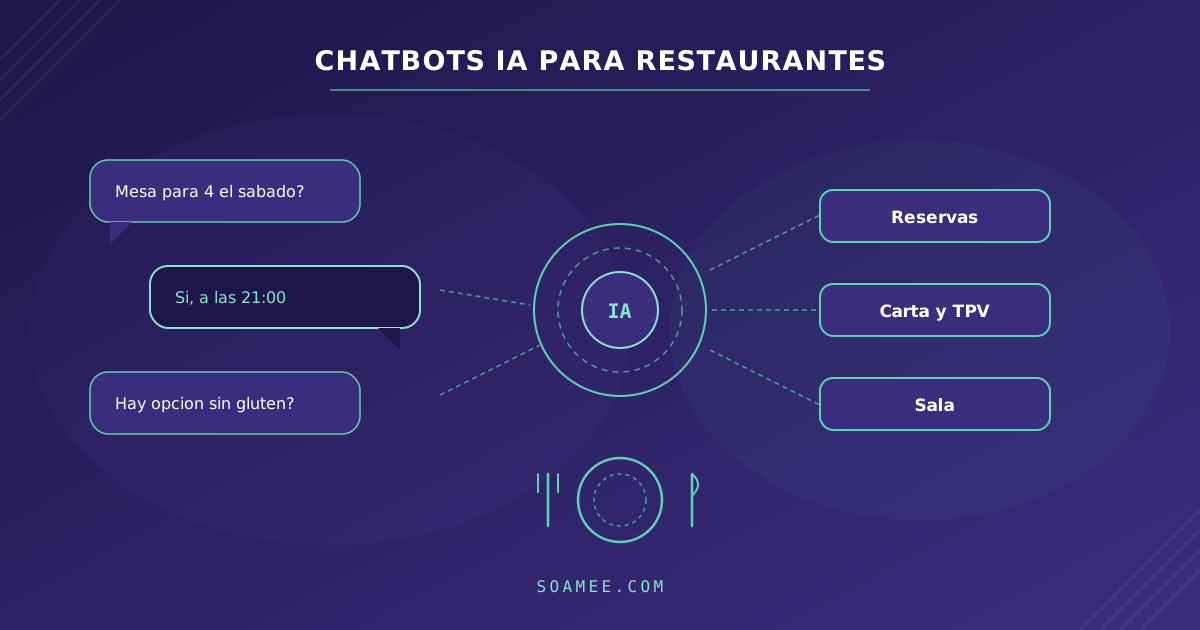
In a restaurant, the phone always rings at the worst possible moment. Saturday, 2:10pm, fifteen tables occupied, and someone calls to ask whether you open on Sundays. That call generates no revenue and does interrupt service; the one that would have generated revenue — the booking for twelve — came in at eleven at night, when nobody was answering.
That is the real gap a conversational assistant fills in hospitality. It is not futurism: it is taking the repeated questions off your team’s plate and not losing the bookings that arrive out of hours.
In short: an AI chatbot in a restaurant handles bookings and changes, answers questions about opening hours, location and the menu, takes takeaway orders and covers enquiries outside opening hours. It works when it is connected to the booking system and the real menu. Without that connection it is a form with a conversation on top.
The four use cases that pay for themselves
Bookings and changes
This is the clearest return. The assistant checks real availability, confirms the booking and writes it into the system. It also handles what eats the most time on the phone: moving the time, adjusting the number of guests or cancelling.
The part almost nobody counts is the cancellation. A cancellation that arrives and is recorded at eleven at night frees a table you can sell again; one that sits in a voicemail box is an empty table the next day.
Repetitive questions
Opening hours, address, parking, whether there is a terrace, whether dogs are allowed, whether there are gluten-free options, whether you do a set lunch. That is a very high share of incoming enquiries and it is exactly the work an assistant does well: consistent answers, at any hour, without interrupting anyone on the floor.
Takeaway orders
For takeaway, taking the order through conversation works well if the assistant knows the real menu and what is actually available. The key is the end of the flow: the order has to land in the system as one more ticket, not as a message someone has to type in again. That detail separates automation from fake automation.
Out-of-hours service
A significant share of enquiries arrives between closing and opening, and that is exactly when your competitors are not answering either. Replying there is often the difference between capturing that booking and losing it.
What it takes to make it work
A conversational assistant with no connection to the restaurant’s systems is a pretty demo that disappoints on the second question. These are the pieces it needs:
| Piece | What for | Without it |
|---|---|---|
| Booking system | Real availability and write access | It only collects requests someone processes by hand |
| Structured menu | Dishes, prices, allergens | It makes things up or answers vaguely |
| Opening hours and calendar | Holidays, closures, shifts | It confirms bookings on days you are closed |
| Handover to a person | Complex cases | It gets stuck and the customer leaves |
| Conversation logs | Review and improve | You have no idea what is failing |
The last row is the most neglected and the most useful. Reading the first week of conversations teaches you more about your customers than any survey: questions nobody anticipated show up, and they usually point to something missing from the website.
Allergens: where you have to be careful
Allergen information is regulated — in the EU by Regulation (EU) 1169/2011 on food information to consumers, and most other markets impose equivalent disclosure duties, so check the rules that apply where you operate. A wrong answer has real consequences, both health and legal. A language model generating plausible text about whether a dish contains nuts is precisely what you must not do.
The correct way to set it up:
- The assistant answers only from the official dish record, never from what the model “knows” about cooking
- If the data is not in the record, it says so and hands the conversation to a person
- At any mention of an allergy or intolerance, it recommends confirming with the floor staff
- What was answered, and against which version of the record, is logged
This is not a technical limitation: it is the difference between a system that helps and one that creates a problem. Nor is it a theoretical precaution — your business answers for what its assistant says, as we cover in your company is liable for what your chatbot says. The same applies to any sensitive information — promotions, group prices, cancellation terms: the answer comes from a source of truth, not from the model improvising.
Which channel to start with
WhatsApp and messaging apps. In markets where messaging is the default way people contact a business, this is where they already write, and that saves you the work of changing a habit. Where it is dominant it has the best response rate and fits confirmations and reminders best.
Web widget. Works in every market and catches people at the moment of deciding. Integrated properly, it turns a visit to the menu page into a booking without leaving the site.
SMS and phone. Where messaging apps are not the norm, SMS covers confirmations and reminders reliably. Voice on the phone has the biggest impact, because the phone is what interrupts service most, and it is also the most demanding: you have to deal with background noise, accents and the impatience of whoever is calling. It is worth it when call volume is high and the floor team is saturated at peak times.
Our practical recommendation: start with the channel your enquiries already arrive on, plus the web, covering bookings and frequently asked questions; measure for two months; and only consider voice if the data shows calls are still the bottleneck.
Costs and what to expect
| Approach | Indicative cost | When it makes sense |
|---|---|---|
| Standard platform with bookings | 100-400 EUR/month | Single site, simple flows |
| Platform + custom integration | Project + subscription | Several sites or an in-house booking system |
| Custom agent with POS integration | Development project | High volume, custom flows, voice |
Before deciding, measure two things over two weeks: how many enquiries come in per channel, and what share of them are the ten most repeated questions. If that share is high, the return arrives fast. If every enquiry is different and complex, an assistant will help less than the demo promises.
Common mistakes
- Setting it up without connecting the booking system. The customer thinks they have booked and there is no table. That is worse than having nothing.
- Leaving no way out to a human. Every assistant needs a clear door to the team, visible from the first message.
- Hiding that it is an assistant. Saying it openly builds more trust and sets the right expectations for whoever is writing.
- Setting it up and never looking at it again. The conversations from the first weeks are the best source of improvement you will ever get. An assistant that answers well in the demo can still fail in real service, and we explain why in demo versus production.
- Letting it improvise on sensitive data. Allergens, prices and terms come from a record, always.
How we approach it
At Soamee we build assistants connected to the systems the business already runs on, not decorative layers on top. We know hospitality up close from projects like Orquest in workforce management and GOXO in premium food service, and the underlying work — wiring the assistant to the POS, to bookings and to the menu — is the same one we describe in our guide on how to build an AI agent.
If you are digitizing the restaurant in stages, the assistant pays off far more once the rest is in place: the guide to digitizing a restaurant sets out a sensible order, and in restaurant software we explain what we build for the sector.
Want to know whether it adds up in your case? Tell us how enquiries reach you today and we will tell you frankly whether an assistant will help or whether the problem is somewhere else.