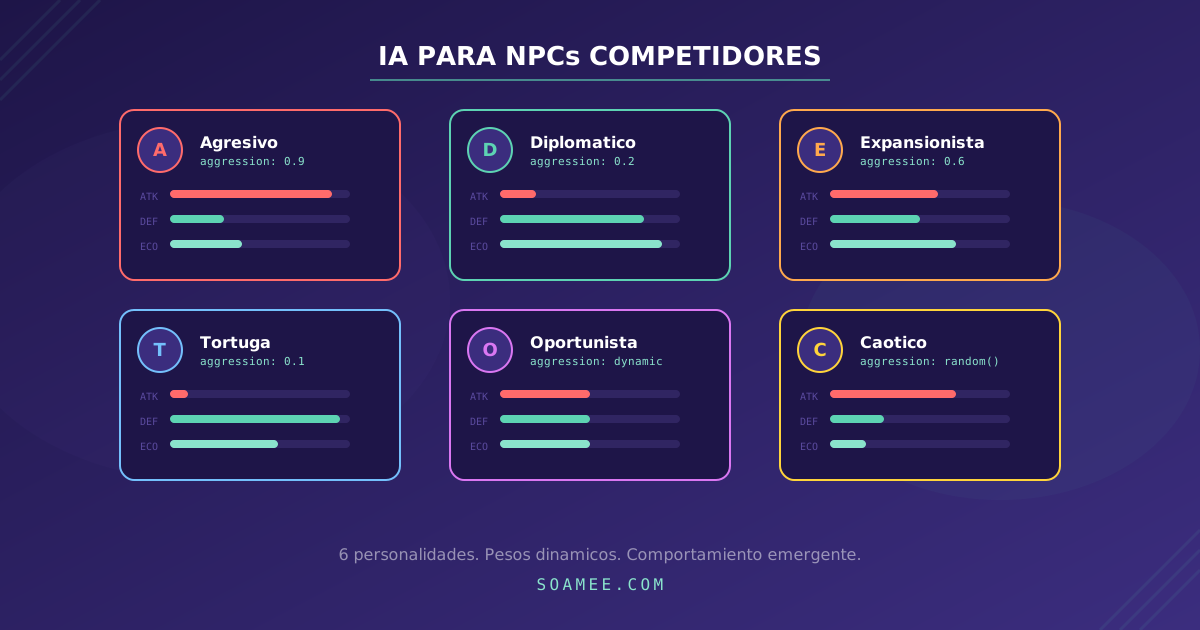
A tycoon without competition is a spreadsheet with nice graphics. The AI competitors in Build Your Empire are designed so that each game feels different, with rivals that make decisions based on their “personality”.
The personality model
Each competitor has 4 parameters:
interface CompetitorPersonality {
  aggressiveness: number;  // 0.0-1.0: probability of attacking
  hireBias: number;        // Weight towards hiring
  launchBias: number;      // Weight towards launching products
  marketingBias: number;   // Weight towards marketing
}
The 6 competitors
| Company | Sector | Style | Aggressiveness |
|---|---|---|---|
| Nebula Systems | SaaS | Aggressive — hires non-stop | 0.8 |
| Kairos Finance | Fintech | Balanced — a bit of everything | 0.5 |
| Vortice Gaming | Gaming | Chaotic — bets on launches | 0.7 |
| Pagina Azul | E-commerce | Conservative — marketing and brand | 0.3 |
| Forja Ciberseguridad | Cyber | Defensive — grows slow but sure | 0.2 |
| Rayo Delivery | Delivery | Opportunist — copies what works | 0.6 |
Decision making
Each day, the engine evaluates for each competitor:
- Got enough cash? — If cash < $20K, does nothing
- Which action? — Weighted random based on their bias
- Attack the player? — Probability = 15% × aggressiveness
The weighted random works like this: if Nebula has hireBias=0.5, launchBias=0.3, marketingBias=0.2, there’s a 50% chance it hires, 30% it launches and 20% it does marketing.
Attack mechanics
When a competitor attacks (15% × aggressiveness per turn):
- 50% talent theft — player loses 1 employee
- 50% innovation sabotage — player loses innovation points
This creates tension moments: you see in the notification bar “Nebula Systems stole one of your employees” and you have to decide whether to counter-attack by hiring or ignore it.
Bankruptcy
If a competitor reaches cash ≤ 0, they go bankrupt. They’re removed from the game and a notification appears. This reduces competition but also interactions — an interesting trade-off for the player.
What we learned
- Clear personalities > complex AI — you don’t need neural networks, just well-chosen weights
- Aggressiveness is the most important parameter — it creates narrative tension
- Players name their rivals — “Nebula always steals my people” generates emotional engagement
- Bankruptcy is satisfying — seeing an aggressive rival fall is a mini-achievement
- Balance between competitors matters — if all are aggressive, the game is frustrating